

Appearance
DevNet Structure & Entities
Complete overview of ASI:Chain DevNet architecture, components, and how they interact.
Network Overview
ASI:Chain DevNet is a development blockchain network designed for testing and experimentation. It consists of multiple interconnected components that work together to provide a complete blockchain ecosystem.
Current Configuration:
- Network Name: DevNet (Development Network)
- Status: Active
- Purpose: Testing, development, and learning
- Token Type: Test tokens (no real value)
Network Components
1. Bootstrap Node
Role: Network entry point and peer discovery
Function:
- Acts as the initial connection point for new nodes
- Maintains a list of active network participants
- Facilitates peer discovery
- Does not participate in consensus or validation
Technical Details:
- Host:
54.152.57.201 - Port Range: 40400-40405
- Connection String:
rnode://0d1312b556db1d3fa4745fd88c29f8e15095621e@54.152.57.201?protocol=40400&discovery=40404Key Characteristics:
- Single bootstrap node for the network
- Always-on availability
- No validator responsibilities
- Essential for network operation
2. Validator Nodes
Role: Consensus participants and block producers
Function:
- Validate transactions
- Propose new blocks
- Participate in consensus
- Sign blocks with validator keys
- Maintain network security
Technical Details:
- Current Count: 3 active validators
- Minimum Required: 3 validators for network operation
- Consensus: CBC Casper
- Block Time: ~20 seconds average
Validator Requirements:
- Valid public/private key pair
- Sufficient stake (on mainnet, not required on DevNet)
- Proper network configuration
- Open ports for communication
- Reliable uptime
External Validators: The network supports external validators joining:
- Anyone can become a validator
- Create wallet on wallet.dev.asichain.io
- Get test tokens from faucet
- Follow setup guide
3. Observer Node
Role: Read-only network participant
Function:
- Synchronizes with blockchain
- Provides read access to data
- Does not participate in consensus
- Does not sign or propose blocks
- Powers external services
Technical Details:
- Host:
54.152.57.201 - HTTP Port: 40453
- gRPC Port: 40451
- Port Range: 40450-40455
Use Cases:
- Blockchain explorers
- API services
- Data indexing
- Network monitoring
- Application backends
Public Access:
HTTP: http://54.152.57.201:40453
gRPC: 54.152.57.201:40451
Network Services
Block Explorer
Purpose: Visualize and explore blockchain data
Access: explorer.dev.asichain.io
Features:
- Real-time block monitoring
- Transaction search
- Validator statistics
- Network performance metrics
- WebSocket live updates
Data Source: Connected to Observer Node
Blockchain Indexer
Purpose: Index and organize blockchain data
Access: explorer.dev.asichain.io/indexer-status
Features:
- Fast data retrieval
- Indexed transactions and blocks
- Historical data access
- Efficient queries
Function: Powers the Block Explorer.
ASI Wallet
Purpose: User interface for blockchain interaction
Access: wallet.dev.asichain.io
Features:
- Account management
- Token transfers
- Smart contract deployment
- Integrated Rholang IDE
- Transaction history
- Multi-account support
Connection: Direct peer-to-peer to validator and observer nodes
Faucet
Purpose: Distribute test tokens
Access: faucet.dev.asichain.io
Features:
- Request test tokens
- No authentication required
- Transaction status tracking
- Balance display
- Simple interface
Function: Sends test ASI tokens to specified addresses
Network Architecture
Visual Diagram
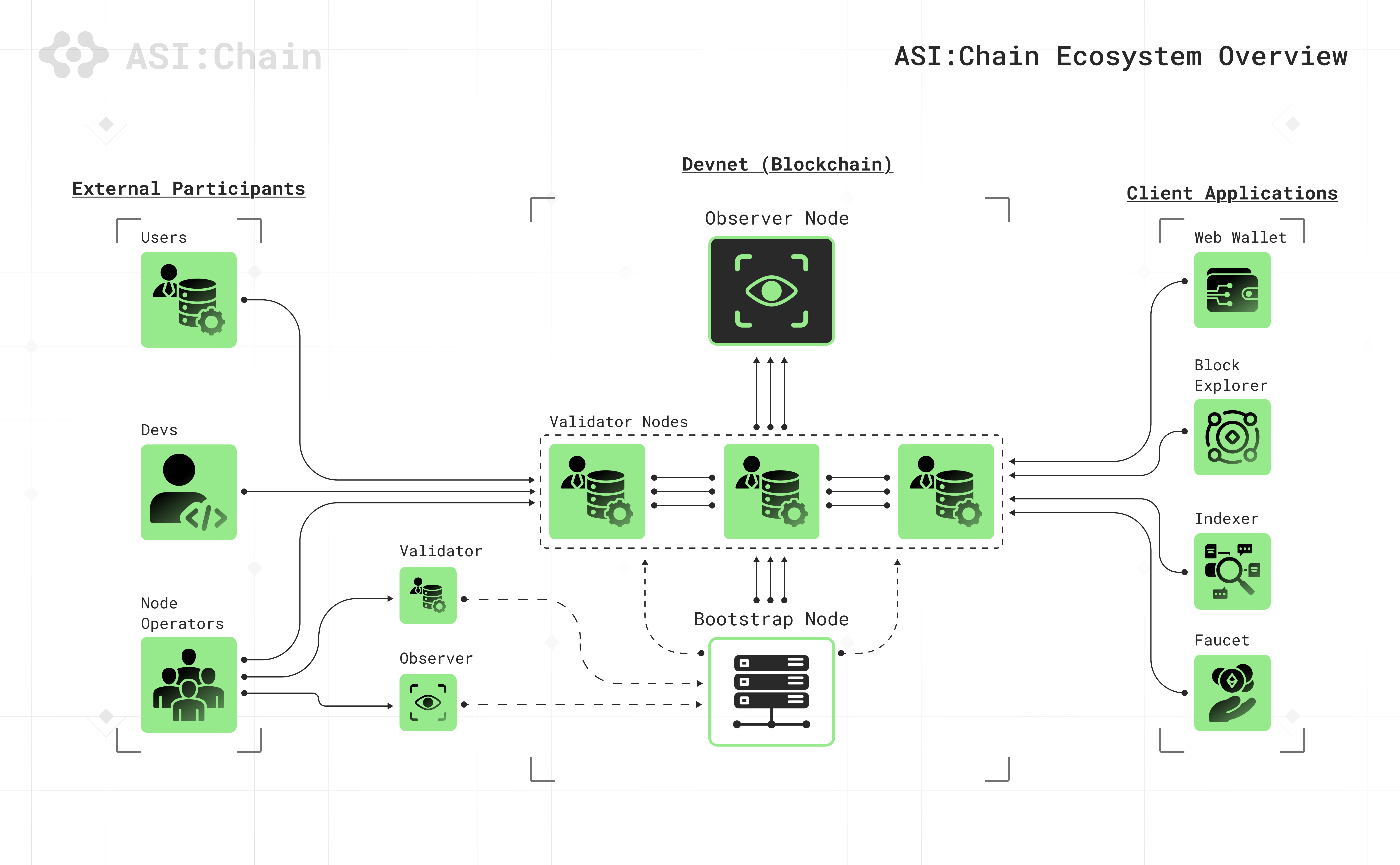
Communication Flow
New Node Joining:
- Node connects to Bootstrap Node
- Bootstrap provides peer list
- Node connects to Validators
- Node synchronizes blockchain
- Node participates (if validator) or observes
Transaction Flow:
- User submits transaction to Validator
- Validator validates and broadcasts
- Other validators receive transaction
- Consensus reached on new block
- Block added to chain
- Observer synchronizes new block
- Explorer/Indexer update display
Data Query Flow:
- User requests data via Wallet/Explorer
- Request routed to Observer Node
- Observer queries local blockchain copy
- Response returned to user
- Data displayed in interface
Port Allocation
Bootstrap Node
| Service | Port | Purpose |
|---|---|---|
| Protocol | 40400 | Node communication |
| Public gRPC | 40401 | External API |
| Internal gRPC | 40402 | Internal API |
| HTTP API | 40403 | HTTP access |
| Discovery | 40404 | Peer discovery |
| Admin | 40405 | Administration |
Validator Nodes
Validators use similar port ranges (404X0-404X5 pattern) but are not publicly exposed for security.
Observer Node
| Service | Port | Purpose |
|---|---|---|
| Protocol | 40450 | Node communication |
| Public gRPC | 40451 | External API |
| Internal gRPC | 40452 | Internal API |
| HTTP API | 40453 | HTTP access |
| Discovery | 40454 | Peer discovery |
| Admin | 40455 | Administration |
Network Parameters
Consensus Configuration
Algorithm: CBC Casper Minimum Validators: 3 Fault Tolerance Threshold: 0.99 Average Block Time: ~20 seconds Finality: Probabilistic
Network Topology
Type: Mesh network Connectivity: Peer-to-peer Discovery: Kademlia-based Bootstrap Required: Yes
Resource Requirements
For Validators:
- CPU: 4-8 cores
- RAM: 16-32 GB
- Storage: 250+ GB
- Network: Stable, low latency
For Observers:
- CPU: 2-4 cores
- RAM: 8-16 GB
- Storage: 250+ GB
- Network: Stable connection
Security Model
Network Security
Validator Authentication:
- Public/private key cryptography
- ED25519 signatures
- Key-based node identity
Communication:
- Encrypted peer connections
- Secure protocol implementation
- DOS protection
Consensus Security:
- Byzantine fault tolerance
- Stake-based participation (mainnet)
- Multiple validator requirement
Data Integrity
Block Validation:
- Cryptographic hash chains
- Merkle tree verification
- Signature validation
State Consistency:
- Replicated state across validators
- Synchronization protocols
- Conflict resolution
Scalability
Current Capacity
Transactions: Limited by block size and time Throughput: ~0.01-1 TPS (test network) Block Size: Configured limit State Size: Growing with usage
Joining the Network
As a User
- Create wallet account
- Request test tokens
- Start making transactions
- Deploy smart contracts
As a Validator
- Meet system requirements
- Generate validator keys
- Configure node software
- Connect to bootstrap
- Participate in consensus
See Join DevNet as Validator for details.
As a Developer
- Get test tokens
- Use wallet or CLI tools
- Deploy contracts
- Build applications
- Access via observer node
Monitoring
Network Status
Check network health:
- Block Explorer
- Validator uptime
- Block production rate
- Transaction throughput
Individual Node
Monitor your node:
bash
# View logs
sudo docker logs validator -f

# Check status
curl http://localhost:40403/status

# Monitor resources
docker stats validator
Support
For more information:
This network is for development and testing. All tokens have no real value.